What are the units on a peptide label and a syringe?
Four units show up in every reconstitution, and most errors come from mixing two of them up. The vial is labeled by mass, almost always in milligrams (mg). Doses are usually written in micrograms (mcg), a unit a thousand times smaller. Once water goes into the vial the dose has to be measured as a volume, in milliliters (mL). And the syringe or pen does not show milliliters: a U-100 insulin syringe is marked in units, and a peptide pen counts clicks, each of which is 0.01 mL.
- 1 mg
- 1,000 mcg Milligrams to micrograms: multiply by 1,000. 0.25 mg is 250 mcg.
- 1 unit (U-100)
- 0.01 mL 100 units fill 1 mL. 10 units is 0.1 mL, 50 units is 0.5 mL.
- 1 pen click
- 0.01 mL The same volume as a U-100 unit, so clicks and units are interchangeable numbers.
- IU
- Not a mass An international unit measures biological activity and is defined separately for each substance. No fixed conversion to mg.
How does a mcg dose become syringe units?
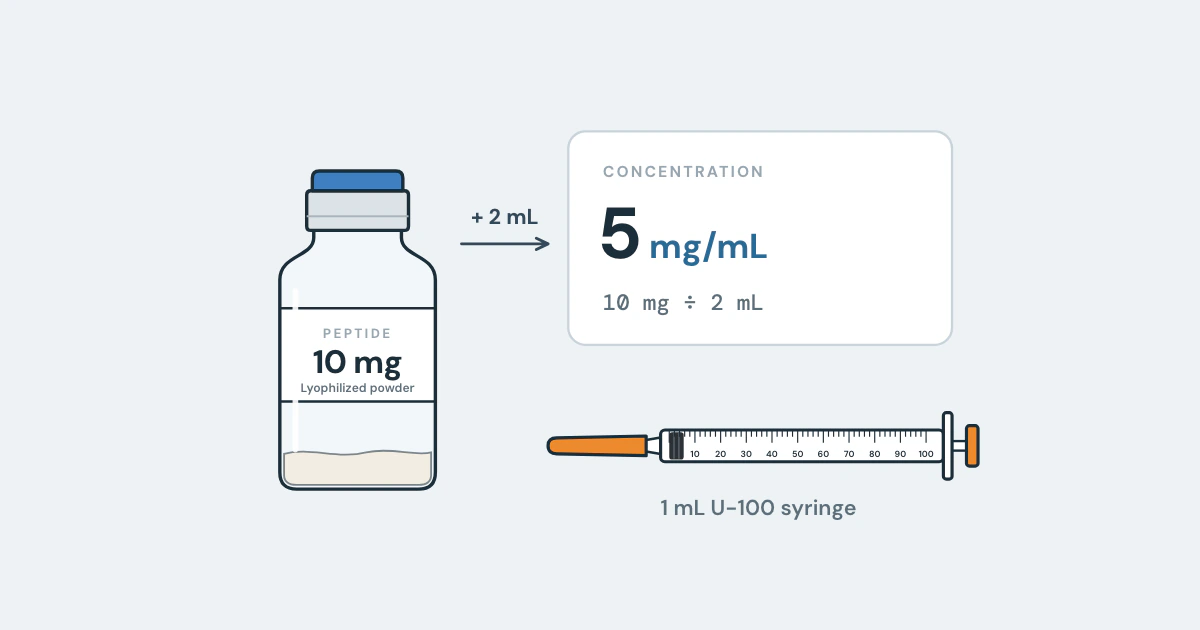
Three steps, always in the same order. First the concentration: the milligrams in the vial divided by the milliliters of water added. Then the volume: the dose in milligrams divided by that concentration. Then the reading: milliliters multiplied by 100 for a U-100 syringe or a pen.
- 1Concentration = vial mg / water mL
A 5 mg vial with 2 mL of bacteriostatic water is 5 / 2 = 2.5 mg/mL.
- 2Volume = dose mg / concentration
A 250 mcg dose is 0.25 mg. 0.25 / 2.5 = 0.1 mL.
- 3Units = volume mL x 100
0.1 mL x 100 = 10 units on a U-100 syringe, or 10 clicks on a pen.
Change the water and only the concentration moves. The same 5 mg vial with 1 mL of water is 5 mg/mL, so the same 250 mcg dose is 0.05 mL, or 5 units. Less water means a smaller draw that is harder to read; more water means a larger one. The amount of peptide in the dose does not change either way.
How many units is 100, 250, 500 or 1,000 mcg?
It depends entirely on the concentration, which is why there is no single answer to "how many units is 250 mcg". The table gives the exact draw for the vial sizes and water volumes people use most. A draw that lands on a half unit (12.5, 7.5) sits between the marks on a 1 mL syringe; a different water volume, or a 30- or 50-unit syringe with finer marks, removes the problem.
| Vial | Water | Concentration | 100 mcg | 250 mcg | 500 mcg | 1,000 mcg |
|---|---|---|---|---|---|---|
| 2 mg | 1 mL | 2 mg/mL | 5 units | 12.5 units | 25 units | 50 units |
| 2 mg | 2 mL | 1 mg/mL | 10 units | 25 units | 50 units | 100 units |
| 5 mg | 1 mL | 5 mg/mL | 2 units | 5 units | 10 units | 20 units |
| 5 mg | 2 mL | 2.5 mg/mL | 4 units | 10 units | 20 units | 40 units |
| 5 mg | 3 mL | 1.67 mg/mL | 6 units | 15 units | 30 units | 60 units |
| 10 mg | 1 mL | 10 mg/mL | 1 units | 2.5 units | 5 units | 10 units |
| 10 mg | 2 mL | 5 mg/mL | 2 units | 5 units | 10 units | 20 units |
| 10 mg | 3 mL | 3.33 mg/mL | 3 units | 7.5 units | 15 units | 30 units |
Reading the table the other way is just as useful: at 2.5 mg/mL, every unit on the syringe carries 25 mcg, so 4 units is 100 mcg and 20 units is 500 mcg. The next table lists what one unit, 10 units, 20 units and 50 units carry at each common concentration.
| Concentration | 1 unit | 10 units | 20 units | 50 units |
|---|---|---|---|---|
| 1 mg/mL | 10 mcg | 100 mcg | 200 mcg | 500 mcg |
| 2 mg/mL | 20 mcg | 200 mcg | 400 mcg | 1000 mcg |
| 2.5 mg/mL | 25 mcg | 250 mcg | 500 mcg | 1250 mcg |
| 3.33 mg/mL | 33.3 mcg | 333 mcg | 666 mcg | 1665 mcg |
| 5 mg/mL | 50 mcg | 500 mcg | 1000 mcg | 2500 mcg |
| 10 mg/mL | 100 mcg | 1000 mcg | 2000 mcg | 5000 mcg |
How many mL is 10 units, 50 units or 100 units?
On a U-100 syringe the conversion is fixed: divide the units by 100. Ten units is 0.1 mL, 25 units is 0.25 mL, 50 units is 0.5 mL and 100 units is 1 mL, which is the whole barrel of a 1 mL syringe. The three common barrels hold 30, 50 and 100 units (0.3, 0.5 and 1 mL). The "U-100" on the label means the syringe was designed for insulin at 100 units per mL; the marks are volume marks all the same, which is why they work for any liquid.
Are pen clicks the same as syringe units?
In volume, yes: a peptide pen dials 0.01 mL per click, the same as one U-100 unit, so a draw of 15 units is 15 clicks. The differences are in the hardware. A pen holds a 1.5 mL or 3 mL cartridge and dials up to a maximum of 30, 60 or 80 clicks per injection, so a large dose may need two injections. Each injection also loses about 1.5 clicks to priming, which the calculator deducts when it counts how many injections a cartridge gives.
What is an IU, and can it be converted to mg?
An international unit is a measure of biological activity agreed for one substance at a time, so an IU of one hormone has no relation to an IU of another, and there is no general IU-to-mg conversion. Where a vial is labeled in IU, work in IU throughout: IU per mL is the vial's IU divided by the water, and the draw is the IU dose divided by that. The calculator's IU potency task does exactly this and never invents a milligram figure. One trap on insulin syringes: the "IU" some people use for the water volume means syringe units of volume, where 100 IU is 1 mL, and has nothing to do with the vial's potency.
What are the common conversion mistakes?
- 1Reading mg as mcg, or the reverse
A 2.5 mg dose typed as 2.5 mcg is a thousandfold error. The calculator names the dose it used next to every result; check that the figure and its unit look right before drawing.
- 2Treating units as amounts
"Take 10 units" is meaningless without the concentration. Always carry the vial strength and water volume with the number.
- 3Forgetting the water volume in the concentration
A 5 mg vial is not 5 mg/mL unless exactly 1 mL went in. Concentration is milligrams divided by the milliliters actually added.
- 4Rounding up every time
Rounding every draw up quietly raises the dose. The calculator rounds to the nearest whole mark and tells you how far off that lands.
- 5Confusing U-100 units with IU on the label
Syringe units measure volume; the label's IU measures activity. The two share a name and nothing else.
The methodology page sets out every formula, rounding rule and capacity threshold the calculator applies, and the unit converter does the mg, mcg, mL and IU arithmetic on its own.